

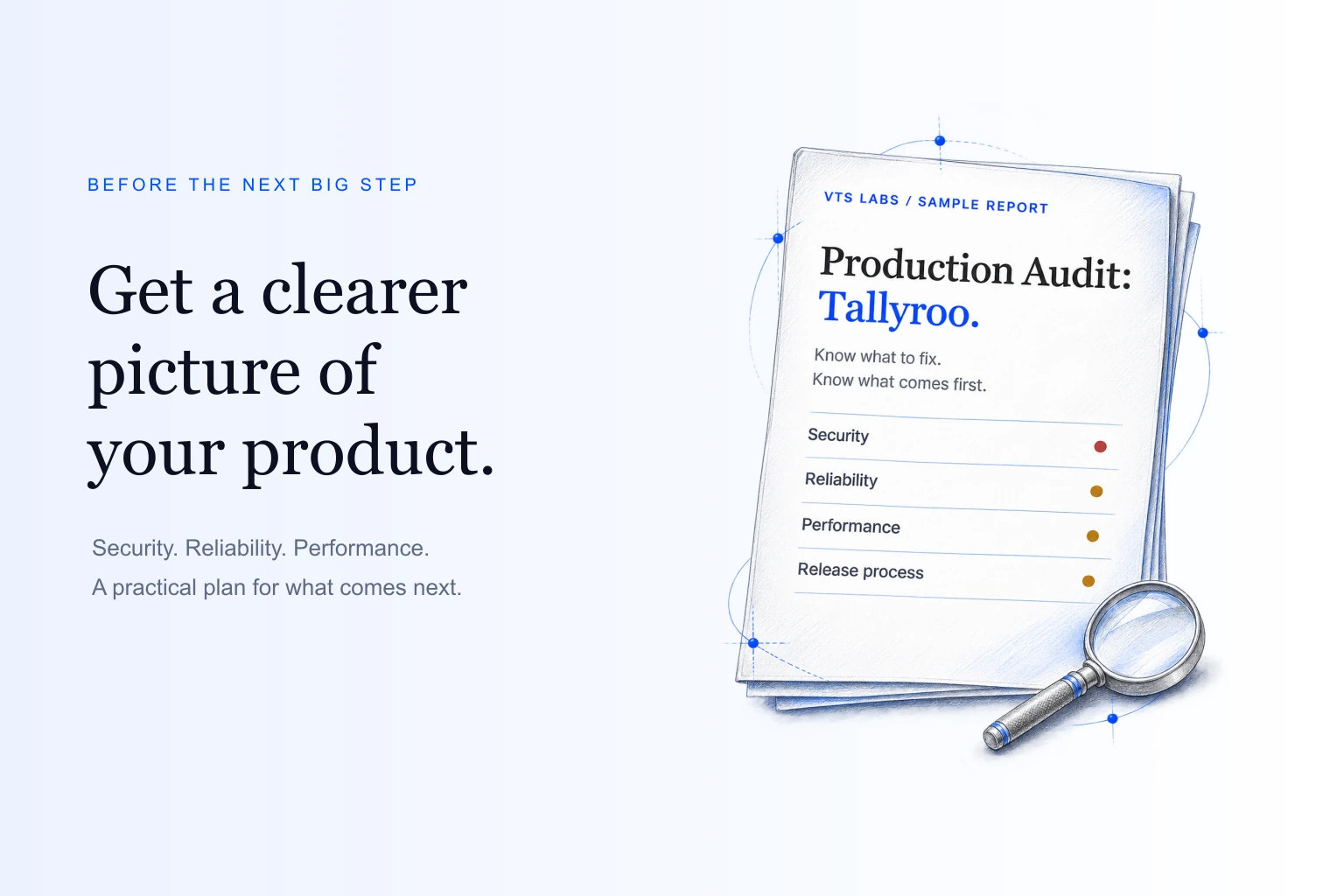
Your product is live. People can sign up, book a service or complete a purchase. You are ready to bring in more customers, hand the product to a new team or talk to investors. The next question is whether the systems behind that experience are ready too.
Bubble, Lovable, Cursor and outside development teams offer different ways to get a product built. The route you chose does not, by itself, tell you whether your product is secure or reliable. That depends on its configuration, code, integrations and operating practices.
A production audit examines those details and turns the findings into an ordered plan. We look for risks that could disrupt your next launch, expose customer information or make recovery harder when something fails.
The problems worth looking for
We focus on problems that affect customer trust, revenue and your team’s ability to keep the product running.
One customer can reach another customer's data.
A page may show only the current customer's records while the underlying request can retrieve someone else's. We check whether the server enforces who can read or change each record. In Bubble, this includes the relevant privacy rules. In a custom backend, we check the access rules in the server code and database.
A secret is included in the browser build.
Browser code is available to the person loading it. A payment-service secret or a database key with administrative access should not be there. Some providers intentionally supply public keys. We check what each key can do and whether a secret has been exposed. If it has, replacing it is an immediate priority.
The product becomes slow as the work grows.
A schedule that loads a handful of records may behave differently with a full year's bookings. Repeated requests, oversized images and unnecessary data can slow it down. We examine important journeys, data volumes and how many people use them at the same time. We then identify the changes and further testing needed.
Backups exist, but nobody has recovered the product.
A backup setting is a starting point. The business also needs to know whether its data can be restored, which systems it depends on and who can perform the recovery. We look for evidence of a successful restore and agreed limits on downtime and lost data. If nobody has tested recovery, we put that on the action plan.
Customers are the outage alert.
Hosting logs can help an investigation, but somebody needs to hear about a failure while there is still time to act. We examine error alerts, checks that the service is available and who responds. The question is whether your team notices a broken booking or checkout journey before customers have to tell you.
A bad release has no tested way back.
An automatic deployment can make releases fast while leaving recovery unclear. We check how changes are reviewed, tested in a separate environment and checked against essential customer journeys. We also look at the steps for reversing a failed update. Restoring yesterday's code may not undo changes to the database, so the recovery plan needs to cover both.
What an audit covers
We start with your product and the decision you are trying to make. Are you preparing for a launch, assessing a contractor handover or investigating recurring failures? That determines which areas deserve attention first.
One of our senior engineers walks through the important customer journeys, usually the ones that earn revenue, such as booking or checkout. We review the available code or platform configuration with read-only access, along with the hosting, database, security and release settings those journeys depend on. We agree access and testing boundaries with you first.
For no-code products, we examine the platform rules and workflows behind those journeys. Where access is missing, we say so and explain what we need to check next. A production review is not a full penetration test.
We turn the findings into a short report you can use with your team: what needs attention, why it matters and what to do next.
See the format in practice. Get the sample report ↓
What you should receive
We start with the risks that most affect the business. Could customer information cross account boundaries? Could a release stop bookings? Could your team restore the data if something went wrong? The summary and scorecard show the priorities and the evidence behind them.
Each finding explains what we found, why it matters, how to fix it and how to check the repair. Your developer gets a specific task and a clear way to confirm it works. We also list anything that needs a deeper look and the access or testing required.
We include effort estimates with their assumptions so you can plan the work. Engineer-days describe the work involved. Vendor support, access and approvals can affect when it is finished.
Finally, we put the work in order. Exposed data and secret keys need immediate action. Recovery and alerts often come next, followed by speed and safer releases. The 30-day plan gives your team a practical starting point. The free production audit includes a short report with priority findings, why they matter and what to fix first, plus a walkthrough call. If the findings show that deeper work is needed, we scope and quote a full audit separately.
When a review is most useful
A review can be valuable before a significant marketing push, when a fundraise prompts technical questions, or after a contractor hands over the product. It can also help when small changes repeatedly cause failures and nobody has a clear picture of why.
Choose the review around the next business decision. A founder preparing for growth needs evidence about the critical journeys and operating risks. A team inheriting a product may first need clarity on ownership, access, deployment and recovery.
You leave with a clearer decision about what to fix now, what to investigate and what can wait.
See what the report looks like
Our sample shows the format of the free short report, using Tallyroo, a fictional booking and payments product for fitness studios. It includes seven findings, their business impact, a security review scope and a prioritized 30-day plan.
For your own product, we agree the scope and access first. Book a 15 minute call to discuss a free production audit.
Technical references
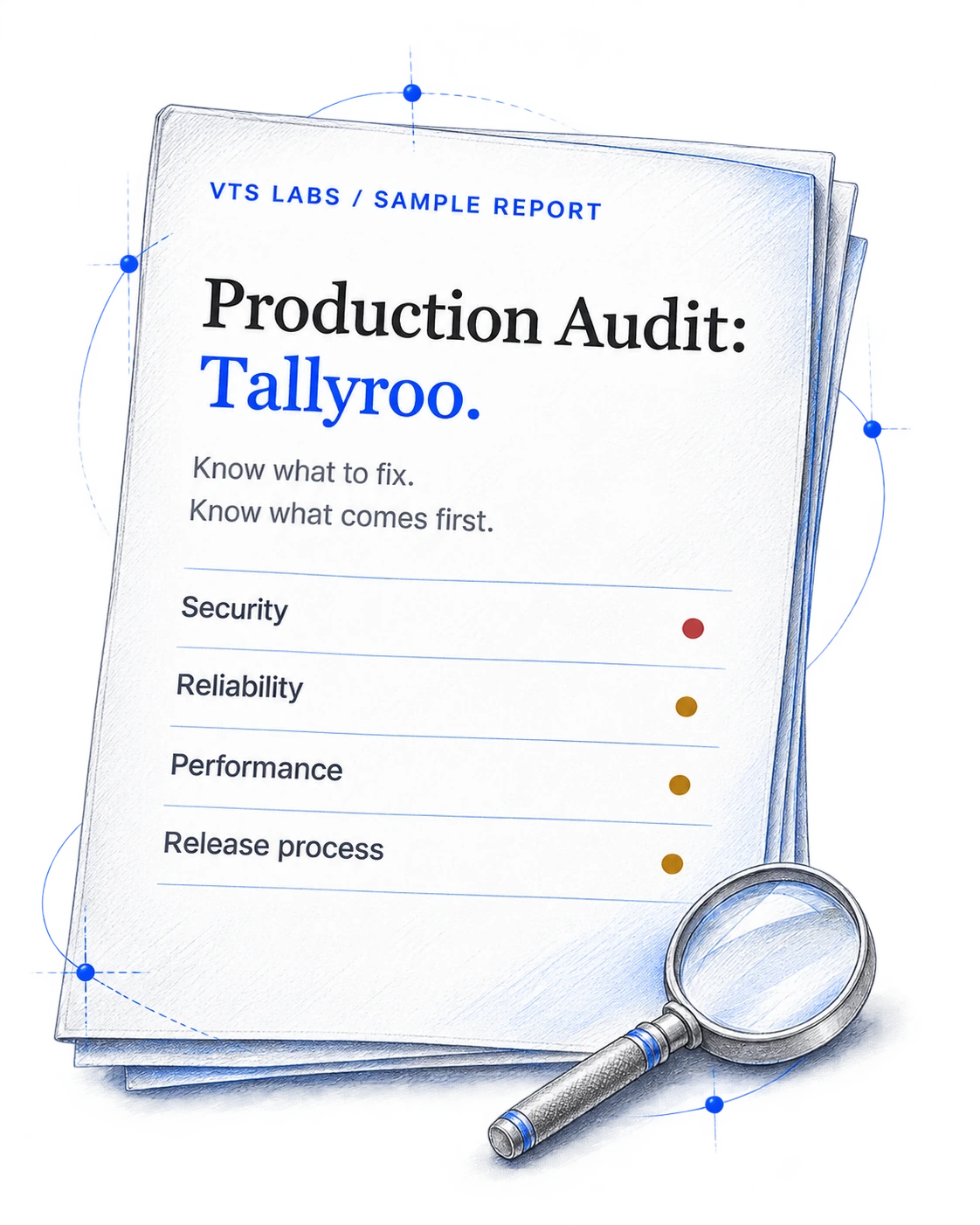
See a sample audit report
See the format of the short report included in your free production audit.
